SHARE
Water Innovation: 3 Technologies Recognized by GPIW
Water innovation has become a global priority. Growing demand, climate change and increasing pressure on water resources are accelerating the search for new technologies to produce, reuse, treat and manage water more efficiently.
What is the Global Prize for Innovation in Water (GPIW)?
In this context, the Global Prize for Innovation in Water (GPIW) was created as an initiative led by the Saudi Water Authority to identify, recognize and accelerate innovations with the potential to transform the water sector.
Since its launch in 2023, the initiative has expanded its scope from desalination to a broader range of water technologies and solutions. In 2025, it received more than 2,500 applications from 119 countries.
At Ennomotive, we find GPIW particularly interesting because it reflects something we see constantly in open innovation: promising solutions can emerge from very different places, from university research groups to technology startups.
These three stories illustrate that well.
Atmospheric Water Harvesting: Guihua Yu’s Water Innovation
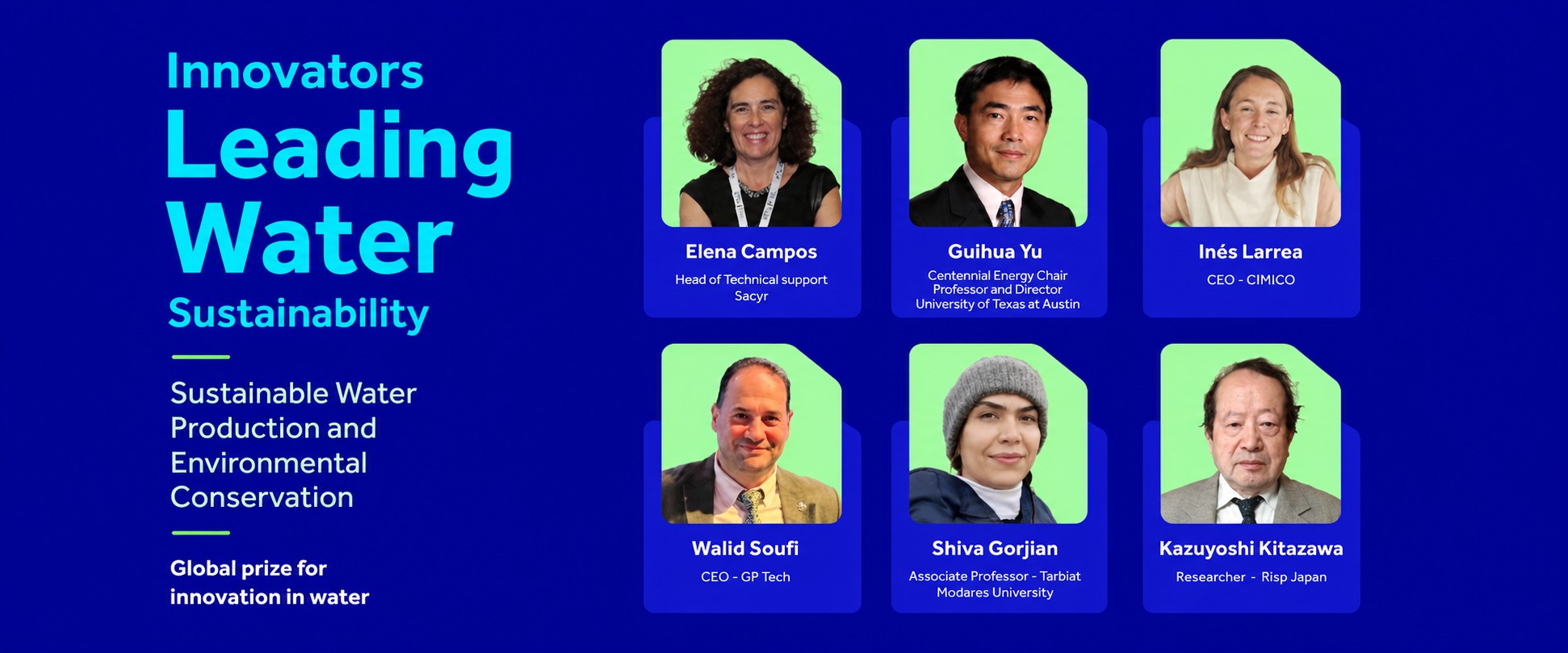
Guihua Yu, professor at the University of Texas at Austin, received the Grand Discovery Prize at GPIW in 2025 for his work on hydrogel-based systems for solar-powered water purification and atmospheric water harvesting.
His team has spent years developing advanced materials to address different challenges related to water access. Their work includes solar-powered desalination and purification systems, materials capable of extracting moisture from the air even in arid conditions, and filtration solutions that can operate without electricity.
These technologies are particularly relevant for areas where water and energy infrastructure is limited. By combining advanced materials with renewable energy, they could enable more decentralized and accessible ways of producing clean water.
The University of Texas at Austin highlighted the scientific originality of Yu’s work, its potential for global impact and its ability to move toward real-world applications.
Chlorine-Resistant Reverse Osmosis Membranes: NALA Membranes
The story of NALA Membranes represents another pathway for water innovation: turning years of scientific research into a technology company.
In 2018, Sue Mecham and Judy Riffle, Professor Emerita at Virginia Tech, founded NALA to develop a new generation of chlorine-resistant reverse osmosis membranes.
Reverse osmosis is a critical technology for desalination, water treatment and water reuse, but conventional membranes face limitations related to chlorine exposure and fouling. NALA has developed a platform based on new polymeric materials designed to improve fouling resistance, reduce cleaning requirements and extend membrane lifetime.
In 2024, Sue Mecham and NALA Membranes were recognized with the Grand Breakthrough Prize at the Global Prize for Innovation in Desalination, the initiative that preceded the current GPIW.
Since then, the company has continued to develop its technology and advance toward industrial applications in water reuse and water treatment.
Wastewater Nitrogen Removal: Sacyr Agua and Denitox
Water innovation is also emerging from large industrial companies working to solve very specific operational challenges.
One example is Denitox, a technology developed by Sacyr Agua together with the University of Granada to improve nitrogen removal from high-load wastewater streams while reducing energy and organic matter requirements.
The project, involving Elena Campos, Head of Technical Support for Sacyr Agua’s Treatment Area, was recognized in 2025 with the Global Prize for Innovation in Water (GPIW) in the Sustainable Water Production and Environmental Conservation category. Sacyr also describes Denitox as a technology developed and patented by Sacyr Agua for nitrogen removal from wastewater.
Nitrogen removal is an important challenge in wastewater treatment. Conventional processes can require significant energy and sufficient organic matter, which is not always available in certain high-load streams.
In a pilot test at the Guadalajara wastewater treatment plant in Spain, Sacyr reported up to an 80% reduction in nitrogen and energy savings of up to 50%. The technology is also designed to reduce the amount of organic matter required, lower greenhouse gas emissions and improve the economics of wastewater treatment.
Denitox illustrates another route to water innovation: identifying a specific operational problem in existing infrastructure and developing a new technology to make the process more efficient and sustainable.
Three Different Paths to Water Innovation
A university professor developing new materials to harvest water from the air, a startup creating a new generation of reverse osmosis membranes and a large water company developing a more efficient process for removing nitrogen from wastewater.
These are three very different approaches, but they all demonstrate an important point: water innovation is not limited to one technology or one type of organization. It can come from a new membrane, an absorbent material, a biological treatment process, a sensor, an algorithm, a new approach to water recovery or even a different application of an existing technology.
That diversity is one of the most interesting aspects of GPIW.
The 2026 edition is open to projects at different stages of maturity, from early-stage research and proof of concept to validated and deployed technologies.
If you are working on a technology that could contribute directly or indirectly to the future of water, your project may also have a place in GPIW.
Do You Have an Innovative Water Technology?
GPIW 2026 is looking for projects from TRL 1 to TRL 9 in areas such as desalination, water reuse, wastewater treatment, water efficiency, digitalization, automation and smart water management.