Background
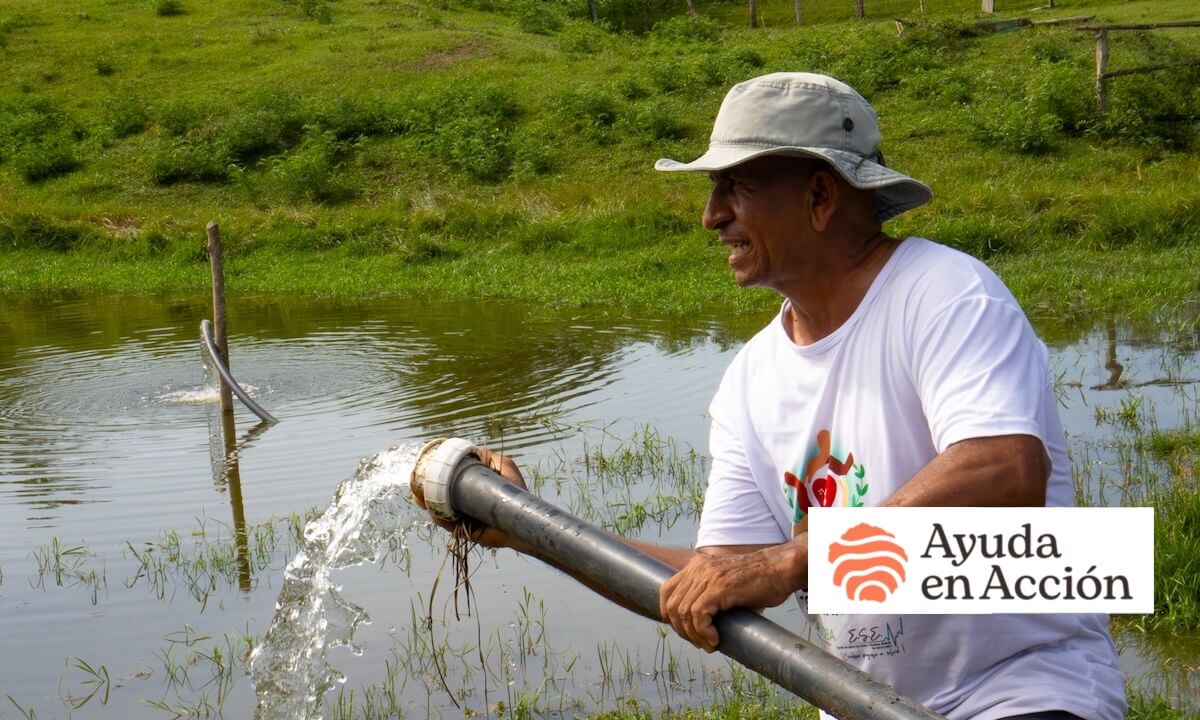
The Ayuda en Acción Foundation has been working since 1981 to improve living conditions and expand opportunities for people and communities in vulnerable contexts. In Colombia, it develops initiatives focused, among other areas, on strengthening rural livelihoods, sustainable production and adaptation to the effects of climate change.
In the Montes de María region, located between the departments of Bolívar and Sucre, family farming and smallholder agriculture play a central role in rural livelihoods and the local economy. At the same time, this is a territory marked by the social and economic consequences of armed conflict, displacement and land abandonment.
Many families are still gradually rebuilding their productive systems, mainly through small-scale family farming, focused on self-consumption and generating supplementary income. Household incomes are limited, and their capacity to invest in their farms is very low.
In this territory, Ayuda en Acción is implementing the “Agroecology and Community Science” project in El Carmen de Bolívar and Córdoba Tetón, in Bolívar, and Ovejas, in Sucre. The project currently involves 8 smallholder farmer organizations, 110 male and female producers, and 852 students from two educational institutions. It is also promoting community biofactories, training processes and applied research through experimental plots.
The Challenge
There are currently difficulties related to water availability and management, soil degradation and loss of soil moisture, increasing rainfall variability, and the adoption and long-term maintenance of certain agroecological practices.
Agriculture depends mainly on direct rainfall, so planting schedules are conditioned by rainfall patterns. Increasing climate variability can interrupt rainfall during critical crop stages, reducing available soil moisture and affecting crop development and productivity.
Annual rainfall ranges from 1,000 to 1,200 mm, with the main rainy periods concentrated in April-May and September-October (200 to 300 mm).
The territory does not lack water resources or infrastructure altogether. In some locations, there are assets such as:
- Farm ponds and reservoirs of different sizes.
- Deep wells.
- Water storage tanks.
- Pumping systems, including solar-powered systems.
- Gravity-fed distribution networks.
- Small community water supply systems.
- Isolated examples of agricultural irrigation systems.
However, water sources are unevenly distributed and there is still incomplete and heterogeneous technical information regarding their capacity, behavior, condition, accessibility and distance from points of use. There is no widespread community infrastructure capable of guaranteeing irrigation throughout the entire crop cycle.
This is compounded by soil degradation, which reduces infiltration and moisture retention while increasing runoff and erosion. Water, soil and agricultural production must therefore be addressed as interconnected elements.
What We Are Looking For
We are looking for frugal, affordable solutions adapted to the rural conditions of Montes de María that can strengthen the capacity of smallholder farmers to sustain their crops during dry periods and increasingly variable rainfall, while improving water and soil management and being locally operated, maintained and replicated.
These solutions should help reduce exclusive dependence on rainfall, whether through supplementary irrigation, improved management of available water, better soil moisture conservation, or other complementary strategies that can help safeguard crops.
A single proposal is not expected to address every component of the problem. Proposals may focus on one or more of the following areas, as examples:
- Water harvesting and storage, through solutions that make use of rainfall, runoff or other available sources, including the improvement, rehabilitation or complementing of existing infrastructure.
- Soil moisture conservation and soil health, through mulching, organic matter, agroecological management, agroforestry, conservation practices, interventions that reduce runoff, erosion and water losses, or other approaches.
- Simple tools to plan water use and adapt planting or farm management decisions to climate variability.
- Efficient water use or localized distribution, when a technically viable water source exists: supplementary systems such as micro-drip irrigation, gravity-fed systems, pumping or other alternatives. Proposals should not assume that sufficient water is available for widespread irrigation.
- Organizational or community governance solutions: operating, maintenance, access or service-delivery models that enable the solution to continue functioning over time.
- Community tools for recording, monitoring, planning or managing water-related information, which can help identify water sources, track their behavior, relate water availability to soil and production needs, and support decision-making. There is currently no clear and unified record of water sources and reservoirs, nor of plots and crops.
This deliberately open approach is intended to avoid restricting the challenge to a digital tool or a specific irrigation system and to allow the emergence of physical, agroecological, technological, organizational or combined solutions.
It is not necessary to develop an entirely new technology. Existing solutions are welcome.
Solutions may be designed at the scale of a single farm, several farms, or for community use, provided that their management and maintenance model is consistent with that scale.
See Annex 1 for information on selected communities and the characterization of example plots that could be used for a potential pilot (to view and download the annex, you need to register for the challenge on the ennomotive platform).
Considerations regarding plots and services
- Farmers’ plots range from approximately 1 to 30 ha. Some educational institutions may have up to 90 ha.
- Soils are predominantly clay loam to clay, with local variations.
- Conventional electricity is available in some locations, while solar energy is associated with certain pumping systems.
- Mobile phone coverage exists, although signal quality and continuity may be intermittent in some areas.
We are looking not only for a technically viable response, but also for people and teams capable of understanding the human context, working with existing assets and knowledge, and proposing solutions with potential for adaptation and replication.
Deliverables
The proposal must be submitted as a PDF document with a recommended maximum length of 10 pages, including:
- Description of the proposed solution and how it works.
- Technical and/or functional design: operating scheme, drawings and diagrams, agroecological practices, organizational model, etc.
- Equipment, materials, infrastructure or resources required.
- Operation and maintenance model, including who could operate the solution, what knowledge would be required, etc.
- Adaptation to the Montes de María context, including requirements related to water, soil, energy, connectivity, infrastructure, knowledge or organization.
- Cost estimate: initial investment, operating costs, maintenance costs, indicative cost per farm, hectare, family or community, depending on the proposed scale.
- Validation or pilot plan: scope, timeline, resources required and cost.
- Expected environmental, social and economic results.
- Replication and scalability potential, explaining how the solution could be adapted to other farms, communities or production systems.
- Team experience and, where available, evidence or similar successful case studies.
Additional supporting documents may also be attached in ZIP format.
Evaluation Criteria
Proposals will be evaluated according to the following criteria:
- Social impact and human-centered approach
Generates visible benefits for families, producers and the community. - Adaptation to the local context
Possibility of implementing, operating, maintaining or repairing the solution using resources, capabilities and stakeholders available in the territory. - Simplicity
Easy to learn, implement, use and maintain. - Environmental impact
Positive contribution to water and soil management, reduction of environmental impacts and consistency with agroecological production principles. - Economic feasibility
Affordable costs for families and the municipality, together with a favorable cost-benefit ratio.
Within these criteria, consideration will also be given to technical robustness, evidence of feasibility, clarity of the maintenance model and consistency between the scale of the solution and its management model.
Structure and Timeline
This is a single-round challenge, with the following schedule:
- Deadline for proposal submission: November 20, 2026.
- Evaluation period: 4 weeks.
Finalist teams may be invited to a meeting to present and defend their proposal.
Prizes
A total prize of €2,500 — taxes included — will be allocated to the solution or solutions selected by the Challenge Committee, which will include representatives of Ayuda en Acción and other stakeholders involved in the project.
The prizes constitute compensation for the selected proposals and do not have to be allocated to carrying out a pilot or implementing the solution.
Any subsequent testing, prototyping or field activities will be assessed independently and will be subject to specific agreements that may be established with Ayuda en Acción and local stakeholders.
Ayuda en Acción reserves the right not to award any category if no proposal meets the minimum evaluation criteria.
------------- Specific Terms and Conditions ------------
Confidentiality
N/A
Intellectual Property
You understand, acknowledge and accept that Ayuda en Acción and, where applicable, the Challenger that created the challenge will have access to your solution.
You also understand, acknowledge and accept that other solvers may create or may have created content that is similar or identical to your solution in terms of concept, subject matter, idea, format or other aspects.
If a solution is identical or similar to that of another solver, Ayuda en Acción or, where applicable, the Challenger reserves the right, at its sole discretion, to award a higher score to one of the solutions in accordance with the terms of the challenge, or to randomly select one solution from among those that meet the challenge conditions.
By participating in the challenge, and if your solution is selected as a winner, you agree that:
- If you propose a previously patented or otherwise protected solution, you will retain its intellectual property rights. Ayuda en Acción and, where applicable, the Challenger will only have the rights of use necessary for this specific project, from its publication as a challenge through any potential pilot and scaling phases.
- If the challenge results in the creation of a new solution or technological application with intellectual property rights, the winning person or team will assign those rights exclusively to Ayuda en Acción and, where applicable, the Challenger, for the purpose of using the solution in social-purpose projects, whether their own or those of third parties.
This assignment will be unlimited in time and territory. Ayuda en Acción will at all times recognize the moral rights of the authors, giving them appropriate credit for their solution and visibility.
Participation in the challenge implies acceptance of the platform’s general terms and conditions.