Background
CMPC is a leading Chilean multinational company with operations in 11 countries and more than 50 industrial facilities. The company produces and markets wood, pulp, and packaging products made from fully renewable sources.
Guided by its purpose, “We create natural fiber for a better future,” CMPC develops solutions that address people’s needs through three core business units: Pulp, Biopackaging, and Wood.
With a strong focus on growth and innovation, CMPC is committed to environmental sustainability, the development of the communities where it operates, and diversity and inclusion, promoting equitable opportunities for all people.
The Challenge
In pulp mills, as well as in other industries such as mining and cement, conveyor belts are critical assets for continuous operations. An unexpected failure in these systems can lead to production downtime and significant operational losses.
Early detection of belt misalignment, thickness loss, splice failures, vulcanized joint defects, and structural damage is essential to ensure operational continuity. It also helps reduce replacement costs, avoid premature disposal of components, and prevent the severe impact of unplanned shutdowns.
CMPC currently follows a scheduled maintenance strategy for its conveyor belts, replacing them every 18 months. However, this approach has proven inefficient. In some cases, unexpected shutdowns have occurred due to belt misalignment and mechanical failures. In others, belts or components with remaining useful life are replaced too early.
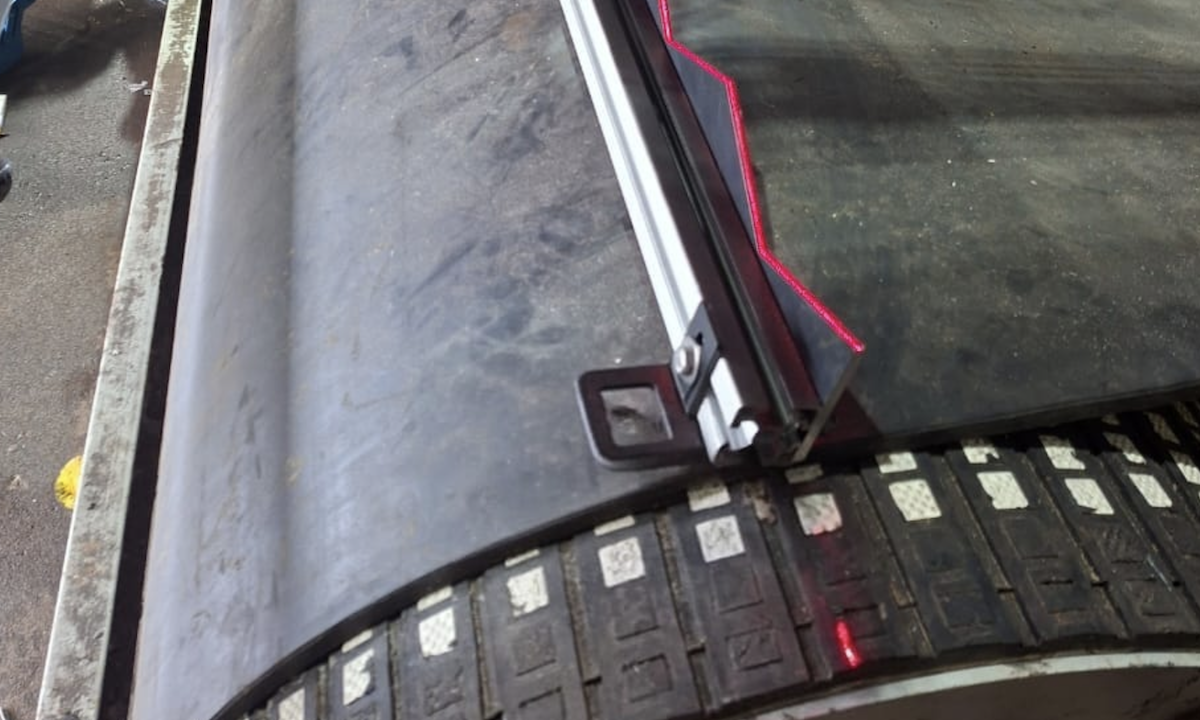
In addition, one of CMPC’s plants has implemented an initial inspection system that detects conveyor belt defects using laser sensors and cameras. This system measures thickness, tears, cuts, cracks, holes, splice damage, grooves, wear, misalignment, and edge damage.
However, the current system has several limitations:
- It only monitors the upper surface of the belt, leaving the inner side uninspected.
- It can generate false alarms due to light reflections, incorrect defect identification, and wood chip dust in front of the camera.
- Although a pressurized air-cleaning system is installed near the camera, dust-related image distortion remains an issue.
As a result, CMPC is seeking more reliable, accurate, and integrated solutions for conveyor belt monitoring, early fault detection, and predictive maintenance.
The technical specifications of the currently installed system are as follows:
- The equipment is installed on the two most critical conveyor belts in the process: the belt transporting wood to the grinder and the belt feeding wood chips to the digester. Both belts are 1.83 meters wide (72 inches) and approximately 500 meters long.
- The system uses 3D optical measurement technology, combining a laser scanner sensor with a 660 nm red laser wavelength and a video camera. It generates three-dimensional surface data from the belt, using X, Y, and Z coordinates.
- The scanner operates with the following approximate measurement resolution:
- 2 mm across the width of the belt.
- 1 mm in height/depth relative to the belt surface.
- Between 2 mm and 20 mm in the direction of belt movement. This longitudinal resolution depends on the belt’s operating speed, which ranges from 1 m/s to 10 m/s.
- Additional sensors are also available at the plant, including:
- Speed sensors.
- Belt position sensors, which operate independently and are used to measure belt misalignment. These sensors are not connected to the current predictive system.
- The plant has a control room with a virtual plant model, or digital twin, where operational alarms are received. However, when an alarm is triggered by the conveyor belt inspection system, the operator must consult the dedicated scanning and alert system computer, as well as inspect the belt if necessary.
- Currently, data from the inspection system is stored only on this isolated computer. The system output is displayed as visual anomaly alerts on screen, showing the defect location, depth, and a 3D image of the detected fault.
- Note: A photographic appendix is available to solvers who complete their registration on the challenge platform.
What the client is looking for
CMPC is seeking efficient, reliable solutions to develop a predictive maintenance system for conveyor belts. The main objective is to detect structural damage at an early stage on the belts used to transport wood to the grinder and feed wood chips to the digester, while significantly reducing false alarms that could undermine the system’s effectiveness.
The final solution must cover the following areas:
- Hardware: The solution may leverage the existing sensors, incorporate new ones, or combine both approaches.
- Predictive Analytics: The solution must include algorithms capable of processing raw three-dimensional sensor data and automatically transforming it into predictive diagnostics. The system must generate automatic alerts early enough to prevent an anomaly from becoming a catastrophic failure.
- Connectivity: The solution must ensure that data is available within CMPC’s established systems, while complying with the company’s current cybersecurity and architecture requirements.
Solutions that address parameters not currently covered, such as monitoring the inner side of the conveyor belt, will be highly valued.
The proposed solution must have a high Technology Readiness Level, ideally TRL 8–9, to enable immediate pilot implementation.
Deliverables
Participants must submit a formal proposal in PDF format, including the following information:
- Proposed Solution
A description of the proposed solution, whether it integrates the existing scanner or uses an alternative approach. The proposal must explain how the solution works and include specifications such as installed sensors, types of defects detected, predictive algorithms, alert system, required investment, and expected results.
Participants are encouraged to include supporting materials such as photos, diagrams, sketches, or technical schematics.
- Pilot Test Proposal
A proposal to conduct a pilot test on one of the conveyor belts at the plant. This section must include the technical scope of the pilot, the minimum equipment required, the proposed implementation timeline, the estimated calibration period for the AI algorithm, and the level of on-site and remote technical support provided.
The proposal must also include a cost estimate for the pilot.
- Success Stories and Supporting Evidence
Evidence of previous use cases or success stories that demonstrate the technical and operational viability of the proposed solution in industrial environments.
Participants may also attach additional supporting documents to strengthen their proposal. These files may be uploaded in compressed ZIP format.
Evaluation Criteria
Proposals will be evaluated based on the following criteria:
- Reliability and Accuracy: Accuracy, consistency, and availability of the data captured and processed by the system, compared with the actual physical degradation of the conveyor belt.
- Predictive Capability: Ability to provide early warnings of potential belt ruptures, critical misalignments, or other relevant failure modes.
- Ease of Integration and Alert Management: Ease of integration with CMPC’s existing infrastructure, systems, and operational workflows, including the quality and usability of the alert system.
- Evidence of Viability: Demonstrated use of the proposed system in other industrial environments or comparable operating conditions.
- Scalability and Return on Investment: A viable cost-benefit model and potential for future scalability across other conveyor belts or facilities.
- Technical Support Quality: Quality and availability of technical support during the pilot implementation at CMPC’s facilities, in Chile or Brazil.
The selected finalists will be invited to a meeting with the client to present and defend their proposals. One or more winners may be selected, particularly if complementary solutions are identified.
Challenge Structure and Timeline
This is a one-round challenge with the following timeline:
- Proposal submission period:
5-> 6 weeks. Submission deadline: August 4, 2026.- DEADLINE EXTENSION until August 11, 2026
- Evaluation period: 6 weeks.
Prizes
An indicative budget of USD 20,000 is available for conducting a proof of concept (POC) on one of the conveyor belts at the plant. The objective of the POC is to evaluate the solution’s performance under real production conditions.
This amount is not a fixed limit. Although it serves as a reference budget, proposals exceeding this amount may be considered if they demonstrate a justified cost-benefit advantage.
Confidentiality
According to the general terms and conditions.
Intellectual Property
According to the general terms and conditions. If a new solution is jointly developed with CMPC, industrial property rights will be shared based on each party’s contribution.